Unleashing the US Economy
February 20, 2026
Doug Leyendecker

Welcome to This Week’s Leyendecker View
It is only through labor and painful effort, by grim energy and resolute courage, that we move on to better things.
– Theodore Roosevelt
FAVORITE READS OF THE WEEK
Seven principles for a 21st-century left
Sound thoughts for all of us.
How AI will reshape society
Change, and likely dramatic change, is inevitable.
THINKING OUT LOUD
Unleashing the US Economy
Are we about to get lucky?
Goldman Sachs’ CEO David Solomon thinks the US economy is on the cusp of breaking out. The stock market seems to be telling us the same thing. Foreign buyers can’t seem to get enough of our stocks. Not so long ago, many economic pundits were expecting a recession. What’s behind this potential turnaround?
For much of the past two decades, the American economy has lived in a strange tension. It has remained innovative and wealthy by global standards, yet it has felt increasingly stagnant to millions of Americans. Many people call this the K-shaped economy, where the well-off keep getting more well-off, and the not so well-off keep losing ground.
For many, wages have failed to outpace the rising costs of health care, housing, and education. Once-thriving manufacturing centers, stripped from their economic vibrancy by globalism, and rural communities have fallen into disrepair and sometimes despair. Instead of improving economic policy, the government tightened regulation while using fiscal and monetary policy to support politically favored industries and a growing entitlement state.
Unleashing the US economy requires more than fiscal and monetary stimulus or redistribution, both of which are top-down government “solutions.” It requires restoring the conditions that allow production, risk-taking, and investment to flourish. Growth does not emerge from administrative edict. It comes from unleashing the private sector.
In recent years, a renewed emphasis on these fundamentals has begun to reshape the national conversation, and President Trump’s economic priorities—deregulation, energy abundance, re-shoring manufacturing, and support for advanced technologies—have played a meaningful role in that shift.
Excessive regulation functions as a quiet tax on productivity. Over time, layers of federal and state rules were accumulated across many industries. Many were enacted with good intentions. But collectively they slowed development, discouraged entry of new competitors, and favored large incumbents who could afford compliance departments.
The collapse of Boeing’s technical and manufacturing prowess is a good example of what happens when regulation stymies competition, even more so when the regulators and the company become co-dependent and complacent.
When regulation becomes too cumbersome, it stymies investment and innovation. Focus shifts from how to make things better to how to satisfy regulators. Trump’s deregulatory efforts signal a new approach to inspiring economic growth.
Trump also recognizes that cheap energy is vitally important to any economic turnaround. Cheap, reliable energy lowers the cost of everything—manufacturing, transportation, food production, home heating and cooling, and newer technologies. When energy is abundant and cheap, inflation moderates and industry thrives. When it is constrained and expensive, economic growth slows and households struggle.
Re-shoring manufacturing is another pillar of a more robust economy. For decades, production moved overseas in pursuit of lower labor costs and regulatory ease. While consumers benefited from cheaper imports, globalization weakened our supply chains, hollowed-out many communities, and made us more dependent on geopolitical rivals who do not share our value systems. The pandemic exposed the fragility of a system optimized purely for efficiency and corporate profit.
Encouraging domestic manufacturing is not about nostalgia. It is about growing resilience. Manufacturing creates a much greater economic multiplier effect than services. Rebuilding domestic goods production capacity will create better paying jobs than Starbucks or Chipotle can. As I’ve said for some time, do we have a minimum wage problem, or do we have a problem not creating enough jobs that pay more than the minimum wage?
No honest assessment can attribute the potential economic acceleration solely to presidential policy. The most powerful force reshaping the economy today is the capital investment boom surrounding AI.
Companies are pouring hundreds of billions of dollars into data centers, chip design, cloud infrastructure, and AI-enabled enterprise systems and consumer products and services. This surge resembles the earlier transformative periods of electrification in the early 20th century and the internet buildout of the 1990s. At first, investment surges ahead of productivity growth. Over time, productivity growth follows.
The productivity gains from AI will not show up instantly in wage statistics. No transition from the old to the new goes smoothly. But so long as history repeats itself, new better paying jobs will emerge as firms reorganize workflows, automate repetitive tasks, and create entirely new products and services. As costs fall and output rises, deflation could pull up the lower income part of our population. But this process requires patience and continued policy alignment.
A transition from stagnation to renewed dynamism will not be painless. Periods of strong growth disrupt entrenched systems. Inefficient firms fail. Regions that relied mostly on government support must adapt. Abandoned regions will take time to rebuild. Creative destruction is uncomfortable, but stagnation is worse.
The temptation in such transitions is to cushion every disruption indefinitely through government expansion. This is why we’re seeing renewed interest in socialism. The displaced naturally want the government to guarantee their economic livelihoods. With national debt already exceeding 120 percent of GDP, the US cannot borrow endlessly to preserve industries, companies, and jobs that are losing their value in the competitive global market. And creating more and more wards of the state holds back necessity, not just the mother of invention but also the mother of get up and get after it. Growth, not redistribution, is the only sustainable path to economic vibrancy.
What makes this moment distinctive is the convergence of political and technological forces. The AI investment boom is arriving regardless of who occupies the White House. But its ultimate impact depends heavily on policy choices. An administration that prioritizes economic growth through cheap energy, deregulation, industrial revival, and technological leadership creates conditions more likely to amplify the productivity surge rather than restrain it.
Presidents do not create economic revolutions by themselves. Innovators, entrepreneurs, engineers, investors, and workers do. These are the private sector forces that Washington can either constrain or unleash. When growth is treated as a moral good—because it expands opportunity and prosperity, strengthens national security, hopefully stabilizes public finances, and can have a unifying effect on the population—policy tends to align with production rather than redistribution.
The US may stand at the edge of a potential expansion not seen in decades. Capital is flowing. Technology is advancing. Constructing a new economic foundation is in process. Manufacturing is regaining strategic importance. Energy resources remain abundant.
We are fortunate that our current technological surge coincides with a president who has placed economic growth at the center of his agenda. If policy continues to favor production over redistribution, the coming decade may mark not just a recovery but also another unleashing of American economic power and prosperity.
THE RANDOMS
Are there any animals in the animal kingdom working relentlessly to change their habitats besides humans?
Interesting that the US military has surrounded Iran and no Muslim nations are objecting.
This NYT article suggests Gen Z (ages 14-29) are locked out of buying a home. How many 14 year olds do you know looking to buy a home? And how many 29 year olds still prefer the flexibility of renting before settling down?
Does the 93% increase in Winter Olympics viewing tell us that the quality of other viewing options is not very good?
Robot dogs could be the biggest robot category of all.
There’s lots of handwringing over the “break up” of the US and Europe. Since when have these two regions really been tied at the hip?
Everyone knows that the United States is a country built on immigration. But how many people know that, for the great majority of our history, when an immigrant came here, there was no social safety net? Most came with nothing and started with nothing. Their aspirations and labor built this country because necessity is not just the mother of invention but also the mother of get up and get after it. Will today’s illegal immigrants be as powerful a force as those legal immigrants from generations past?
Drinking, drugs, disease, and depression, the afflictions of those who die young.
What do you think is more important to the future sustainability of our country and culture, Judeo-Christian values or artificial intelligence?
ECONOMIC NEWS
Economy
Govt shutdown hampers Q4 growth
US jobless claims fall
The Fed yawns at rate cuts
Companies are jacking up prices again
Lower gasoline prices, lower inflation
K economy out, E economy in
Labor
CEO replacements are booming
Desperate job hunters paying for interviews
The new return-to-office battle
The Lone Star
Giant shipbuilding project coming to South Texas
Austin robot company raises big $$$
Texas opens first lithium plant from O&G wastewater
BUSINESS
Finance
Private credit canary in the coal mine
Goldman backs away from DEI
PE gets sued for causing inflation
The Ivies have second thoughts on private equity
Real Estate
Office building delinquency rates grows
Homebuilders are slashing prices
Few homeowners want to sell
Tech
Apple thinks we need more gadgets
Top investor says software is toast
How the Polymarket boom started
Let an algorithm choose your mate
AI
OpenClaw creator joins OpenAI
Big law firm replacing 1,000 jobs with AI
AI is making cybercrime easier
Energy
Mini nuclear reactor heads to Utah
CA has to buy gasoline from the Bahamas
Was 2025 the peak for green tech?
THE NATION
Politics
State Republicans focus on cutting regulation
Democrats shut down immigration enforcement
Moderation, the most disruptive move in politics
Policy
Are tax increases coming to NYC?
The Fed is ready to loosen bank rules
Obama knocks Democrats’ immigration stance
Hillary Clinton does, too
Trump wants voter ID law by midterms
Trade
Japan plans $38B in US investments
Tariff changes coming to steel and aluminum
US and Japan close to energy-chips deal
Culture
Conservatives get their own Cosmo mag
Gen Alpha, the next Greatest Generation?
YouTube, Hollywood’s next threat
OMG, glacial growth is surging
GEOPOLITICS
Global
O&G, the fuel behind Argentina’s turnaround
São Paulo, the world’s party city
Canada has a secessionist problem
How to unleash Cuba
Europe
Germany ready to ban youth social media
Europe is pissing off its companies
Its climate policies inhibit economic growth
Ukraine
Ukraine makes fastest battlefield gain in 2.5 years
Russia’s O&G revenue halves year over year
Ukraine’s neighbors may be helping Russia
Ukraine struggles to keep the lights on
Middle East
US removing all forces from Syria
Trump scolds Israel’s President Herzog
Iran is making mischief and threats
As it pretends to negotiate
Second wave of anger hitting Iran
China
IMF tells China to cut industry subsidies
China’s ByteDance threatens Hollywood
Is a US-China joint car venture coming?
China’s green energy advantage unravels
War Creep
Iran rattles its sabers
North Korea scams fund nuclear weapons
Russia’s Wagner Group is focused on sabotaging Europe
MAKING A BETTER YOU
Mind
What love does to your brain
How to be more work productive
Meditate, anywhere, anytime
Body
The best time to work out
Frozen food can be good for you
Nutritionists can love fibermaxxing
FUN STUFF
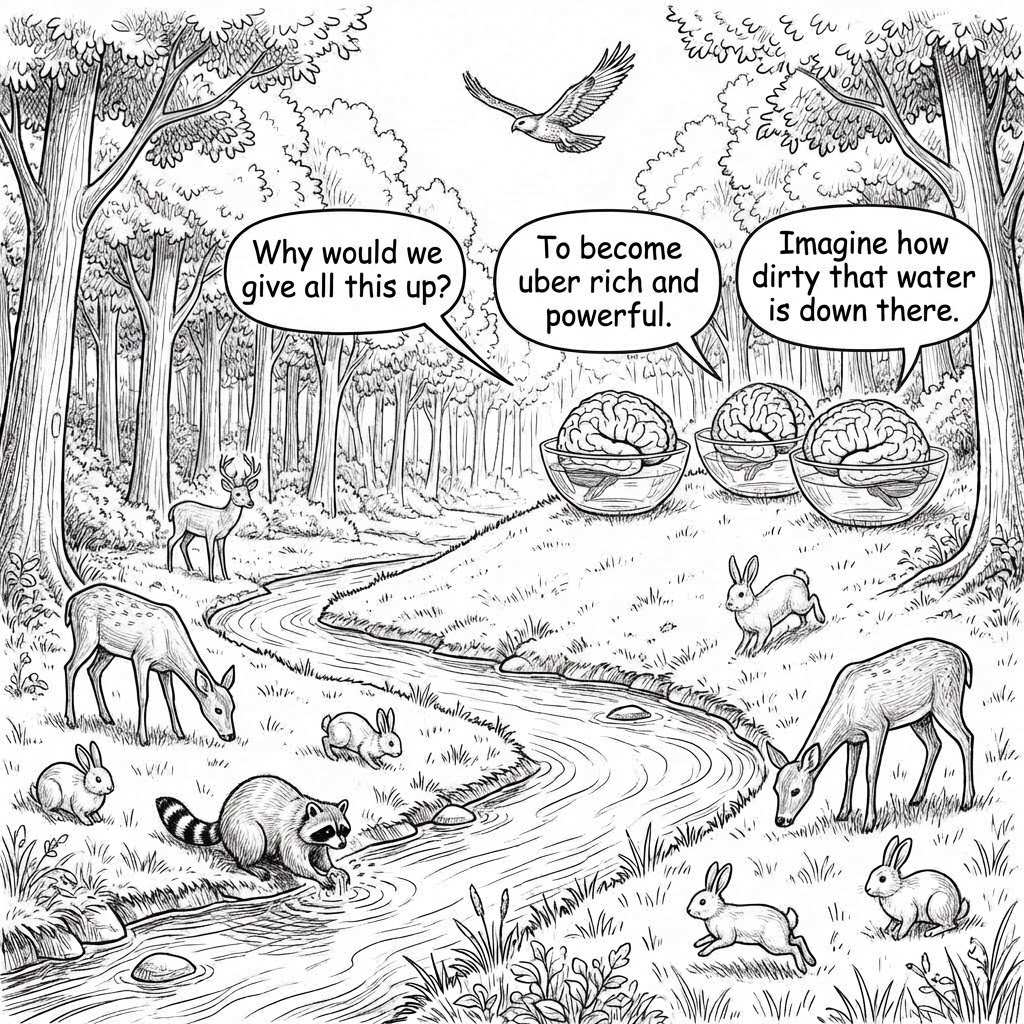
Humans After AI
by Buck Roy and Nano Banana
The Extraordinary
Humans have a third set of teeth
How Roald Dahl changed brain surgery
How did the age of dinosaurs begin?
Music That Found Us
Jazz Cubano
SG Lewis’s “Lifetime.”
Morning meditations ambient music
Worth a Watch
How did we miss Parthenope?
The Devil Wears Prada 2
Guy Ritchie’s Young Sherlock Holmes.
The Yum Yums
Food to keep you warm.
Julia Child’s beef bourguignon
Old-fashioned beef stew
Puerto Rico sancocho
Vietnamese bo kho
Creamy lasagna soup
The ultimate potato soup
PARTING THOUGHTS
A truly American sentiment recognizes the dignity of labor and the fact that honor lies in honest toil.
–President Grover Cleveland
IN CASE YOU MISSED IT
We Need Conservatives and Liberals
February 13, 2026
Uncertainty, the New Normal
February 5, 2026
Our Politics Can Be Brutal
January 30, 2026
Just a sample text from heading element.