The Scammer Economy
May 8, 2026
Doug Leyendecker

Welcome to This Week’s Leyendecker View
One of the things that I love is focusing on the process over the prize.
– Rory McIlroy
FAVORITE READS OF THE WEEK
Yale is the least of higher education’s problem
College just isn’t worth it anymore.
How about organizing a “reverse OPEC”?
An outside the box idea.
THINKING OUT LOUD
The Scammer Economy
Where is it leading us?
Fraud is not a modern invention. It is as old as trust itself.
Wherever humans have exchanged goods, money, or promises, there have been those willing to manipulate that trust for personal gain. What’s changed over time is the scale, speed, and sophistication of scams.
For most of human history, scams were constrained by geography. The classic con artist originally operated face-to-face. Dishonest merchants manipulated the quality, counts, and/or weights of their products. Once mail became prevalent, scammers adapted. In the late 18th and early 19th centuries, scams like the “Spanish Prisoner” circulated through postal systems, promising vast riches in exchange for small upfront payments.
In the 1920s, a period of unprecedented wealth, Charles Ponzi, maybe the most infamous of all modern con artists, bilked unwary people of millions. Also popular at the time were elaborate schemes created to steal money from unsuspecting rich people. The film The Sting provided a glimpse into how these schemes worked. Selling worthless Florida swamp land was also popular during this period. As were stock market and oil drilling scams.
While scammers have always leveraged technologies to improve their deception, today’s technologies have enabled a staggering and evolutionary leap in the scammer’s reach.
The internet, smartphones, and global financial systems have transformed scamming into something scalable, automated, and increasingly anonymous. Today’s con artists do not need to persuade one person at a time, wait for the mail system to deliver a letter, or organize a physical meeting with a potential “mark.” Instead they can target millions simultaneously and anonymously. Email phishing campaigns, text message scams, robocalls, and social media impersonations allow bad actors to cast nets broadly at minimal cost.
Even if only a tiny fraction of today’s targets responds, the sheer volume ensures success. It’s a numbers game, and given the results, it has proven a highly profitable business. The FBI reports that, in 2025, Americans lost around $21B to scams, an increase of around 24% from the previous year. (Check out the charts in that link!)
Where a scam once required charisma, ingenuity, and the gift of gab, now it requires little more than access to contact information, software programs, and our ubiquitous global telecommunications systems.
Entire ecosystems have emerged around fraud: marketplaces for stolen data, services that generate fake companies, websites, and people and even “training programs” that teach newcomers how to scam. What was for millennia an individual grift has become an extremely sophisticated industry.
The financial infrastructure of the modern world has greatly accelerated the scammer economy. Previously, collecting scam proceeds required a face-to-face meeting. Today digital payments and cryptocurrencies allow money to move instantaneously and stealthily, with scammer and victim never having to meet. This speed not only increases the efficiency of scams but also reduces the likelihood of perpetrators being captured and potential recovery for victims.
Historically encountering a scam was relatively rare. Today exposure is constant. The average person now navigates a digital environment saturated with daily deception attempts.
The ubiquity of scams breeds vigilance, but the frequency of attacks can be overwhelming. On one hand, people are more aware of the possibility of fraud, so they are more cautious in their interactions. On the other, the sheer volume of threats can lead to constant fear and emotional fatigue. Distinguishing between legitimate communications and deception becomes a daily cognitive burden.
Scamming is no longer a peripheral activity carried out by isolated individuals seeking economic reward. It is firmly embedded in our modern digital economic and social infrastructures. It uses mainstream business tools to execute its dark business model. It mirrors legitimate enterprise so closely that the distinction between what is real and what is fake becomes ever more difficult to discern.
Unless the world develops a higher set of shared values, it appears our future will include being preyed upon multiple times a day. Technological tools have let the con artist genie out of the bottle. The result may be a world where fewer and fewer people trust each other.
THE RANDOMS
When you see photos of Iranians en masse supporting their supreme leader, realize those are people whose jobs depend on the totalitarian regime remaining in charge. Or they’re there under threat.
Both looking for a job and trying to hire someone are becoming ever more tedious. AI is not helping.
One of the most interesting truths is that we may not really know what is true.
No matter who succeeds Donald Trump as president, they will likely continue his effort to make America great again. What other option is there?
If the key to economic and technological sustainability is decentralization, then why have we put all our eggs into the internet basket?
Today the financial-Goliath investors are telling us there are no problems with private credit. In 2007 the financial Goliath investors were telling us there was nothing wrong in the financial markets. Hmmm…
Isn’t “progress” wonderful? Technology has given us so much more leisure time, and it’s made our leisure time much more leisurely, right?
ECONOMIC NEWS
Economy
US hiring looking good
Jobless claims rise slightly
Map of foreign investment into states
Factory activity expands, but costs are up
Get ready for the $33 burger
Labor
Welders have brighter futures than college grads
A theory on why AI will create more jobs
White-collar sweatshops
The Lone Star
Grimes County could get giant chip factory
Dell moving incorporation from Delaware to Texas
Chinese robotic company moves to Texas
BUSINESS
Finance
BDC private credit challenges getting worse
AI agent day traders aren’t smarter, yet
The $100MM M&A fee world
More pain for private credit and private equity
Real Estate
Home foreclosures are at a six-year high
And are set to rise even more
Tech
Amazon seeks to leverage its supply chain
Meet the robot Buddhist monk
Most VC money invested in California
Who knew Mac Mini was so hot
Robots at work in CVS warehouse
AI
Railroad boom dwarfs AI boom
Will SpaceX buy Anthropic?
Anthropic goes after financial services
AI scams are exploding
AI giants want to take over school
Energy
Peter Thiel backs wave-powered data centers
GM bets big on ICE investments
Renewables find ways to stand on their own
THE NATION
Politics
DC police lied about their crime data
Will the Dignity Act make it through Congress?
The NYT’s latte logic of social collapse
Trump calls for national Shabbat for America’s 250th
Policy
Trump widens Cuban sanctions
Trump expands access to retirement plans
Trump raises European car tariffs
The Presidential Fitness Test is back
Culture
US men are hooked on online gambling
Gen Z does not trust AI
40% of Americans over 60 have no retirement savings
GEOPOLITICS
Global
Mexico City sinks 10 inches a year
Cuba’s leaders thumb their nose at Trump
US trying to rebuild old African railway
Europe
How financialization broke Britain
Trump moves troops out of Germany
German chancellor mistakes Trump for a chump
Ukraine
Has Putin lost the war?
Ukraine goes old school with its drone defense
Ukraine drone strike hits Moscow high rise
Middle East
Project Freedom back on track
US and Iran trade fire in Hormuz
Israel strikes at commander in Beirut
How Iran’s regime stays in control
China
China hands out death sentences for corruption
Chinese court rules to protect workers
China introduces larger cars and trucks
China needs fewer migrant workers
War Creep
China sends warships to the Pacific
Iran gives world a look at US firepower
US to sell $9B in weapons to the Middle East
AI companies flock to Pentagon deals
Japan is building cardboard drones
MAKING A BETTER YOU
Mind
The case for embracing randomness
Healthy brain habits
Bring back the hand-written note
Body
How healthy is tofu?
Are you aging well?
What to know about your eyes
FUN STUFF
The Extraordinary
Amazing magnified sand images
Snow leopard cubs’ first venture outside
The Ethiopian running secret
Music That Found Us
Sofiane Pamart, “Like an Angel”
Sofiane Pamart Paris YouTube Music Nights
DoYeon Kim, “The Song of Swords, Part 1”
Worth a Watch
The Stranger, a new black-and-white film.
Christopher Nolan gives us The Odyssey.
Ted Lasso’s back!
The Yum Yums
Yummy spring meals.
Fennel and apple salad with walnuts
Roasted chicken
Sautéed mushrooms and herbs
Oven-roasted cauliflower florets
Sweet potato hash
Oven-roasted asparagus
Grilled peaches
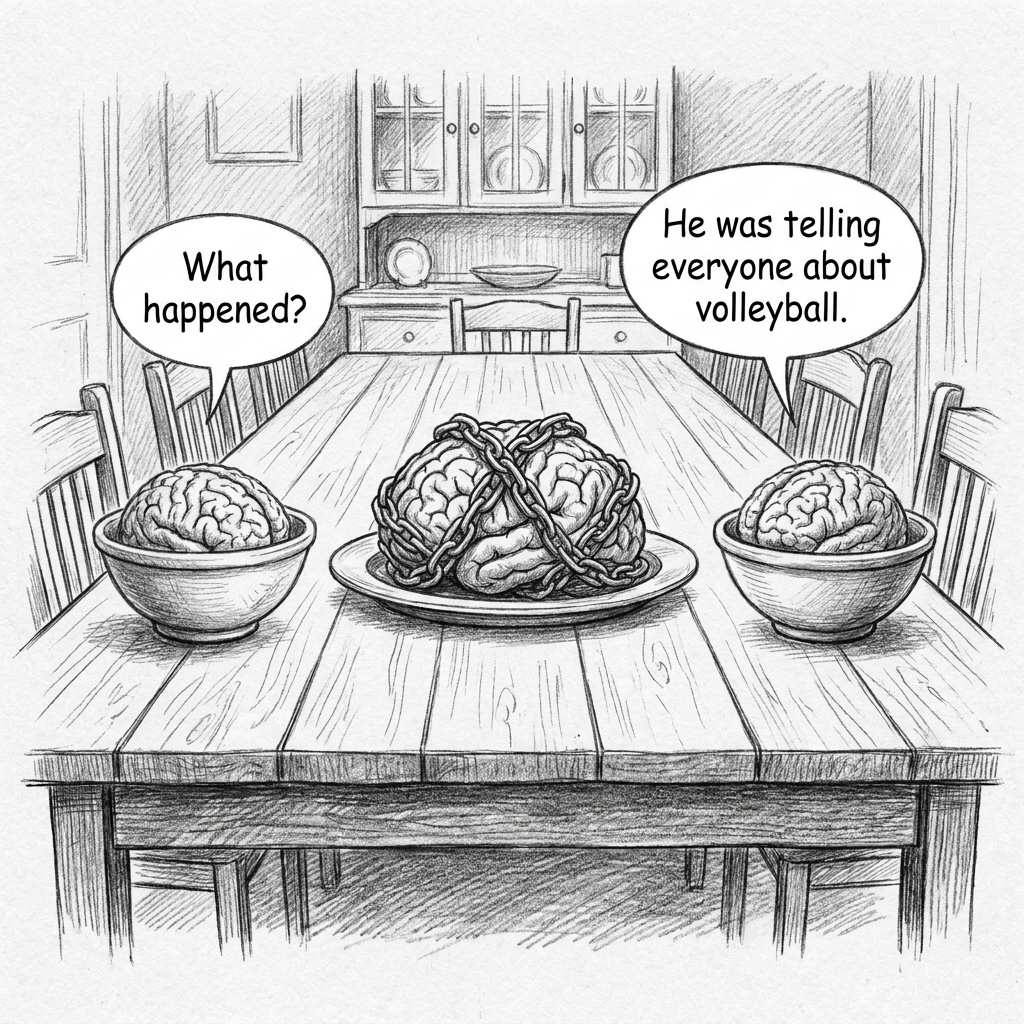
Humans After AI
by Buck Roy and Nano Banana
PARTING THOUGHTS
Wealth isn’t a distinction. If I have no other achievement to my credit than the accumulation of wealth, then I have made a poor success of my life.
– John D. Rockefeller
IN CASE YOU MISSED IT
The Covid Hangover
May 1, 2026
Headhunter’s Secrets: How to Spot a Poor Leader
April 29, 2026
America’s Singapore
April 24, 2026
Just a sample text from heading element.