The Covid Hangover
May 1, 2026
Doug Leyendecker

Welcome to This Week’s Leyendecker View
A society that puts equality before freedom will get neither.
–Milton Friedman
FAVORITE READS OF THE WEEK
RCP8.5 is dead
Climate realism is finally taking hold.
The mystery of good judgment
Where does it come from?
THINKING OUT LOUD
The Covid Hangover
We’re still feeling it
This time six years ago, we were all in some degree of Covid lockdowns. While the virus still circulates annually, along with all the other bugs that do, most of us think little of it. But the effects of the reaction to the virus back in 2020 and 2021 linger, like a hangover that just won’t end.
Covid disrupted our economy to this very day.
The most pervasive and persistent after effect of Covid continues to be the fallout from the massive fiscal and monetary stimulus injected into the economy. The consequent inflation, something we’d not seen for almost five decades, required the Federal Reserve to raise interest rates in 2022. Today interest rates remain elevated.
Inflation affected many consumables, particularly food and real estate. It also affected numerous services the average person can’t live without, creating affordability issues for many Americans. Today’s higher cost to borrow, added to inflated home values, now has housing sales at the 2012-2014 level. When fewer homes are purchased, so too are expenditures to furnish them, which dings our domestic economy.
Covid changed our attitudes about work and family.
When the government shut down businesses and forced people to work from home, it changed the way workers felt about their jobs and families. Most were relieved to avoid cumbersome commutes and instead apply that found time to greater work and personal productivity. And many enjoyed the additional time with family and ability to parent throughout the day.
Today few workers feel immune to lay-offs, so why give employers outsized loyalty and commitment? Furthermore, higher costs have motivated more workers to demand higher wages. Since Covid, the private sector union movement has also shown signs of growing support.
Covid changed geopolitics and is in the process of changing trade.
Covid made obvious the limitations of free trade. As global supply chains seized up, countries became aware of their dependency on global suppliers, not all of whom shared our values. The risk of another pandemic or some other geopolitical fracture has shifted our focus to economic self-sustainability.
The era of hyperglobalization is over. What replaces it is still being negotiated, but the architecture is clearly moving toward a world of allied supply chains and managed competition with China across every sector that touches national security and economic sustainability. Unfortunately, this transition of supply chain and goods production will contribute to inflation as the global economy is restructured.
The lockdown messed with our mental health and social cohesion.
The Covid lockdowns cut off in-person connection and pushed people online. Some people have grown lonely, anxious, and depressed. Others have lost their minds to conspiracy. Too many have drifted into nihilism. And an alarming number have become politically radicalized, convinced that our country is under some kind of urgent existential threat from the “evil” other side.
While our political fracturing was well underway when Covid happened, the lockdowns accelerated its pace and pitch. We remain stuck in an ever-escalating “us vs. them” dynamic, where the stakes seem only to rise, which then exacerbates the extreme ideas and mental health crisis gripping our nation.
It grew our distrust of legacy institutions.
Once Covid was over and the government and healthcare mistakes and obfuscations were exposed, distrust in these institutions grew. Trust in health care, legacy media, social media, education, and even big technology companies has cratered. All of them pushed government propaganda and were conspirators in its deceits and dysfunction.
After such a deep betrayal by institutions we once trusted, who can we rely on now? As the old perspective goes, building trust can take decades but with a single misjudgment, especially one that negatively affected so many, it can quickly unravel.
It changed the way we look at energy.
Covid also put the clean energy narrative on the back burner. The pandemic and consequent inflation made it harder to ignore just how much more affordable and reliable oil, gas, and coal are relative to clean energy.
It also reminded us that a safer and more self-sufficient US—one less susceptible to disruption in the event of another pandemic—requires energy independence. Given that we are rich in hydrocarbons and rely on foreign countries for a large share of clean energy’s infrastructure, Covid put the emphasis back on dependable, accessible, abundant, and cheap domestic energy.
Many of our companies have more challenges.
Higher interest rates have made the value of private financial assets more fragile. We’re starting to see residential real estate values decline off their Covid “free money” ascent. Covid-induced flexible work environments have also significantly reduced the value of many office buildings. And the private equity world has struggled to find liquidity events for their portfolio companies, many of which were acquired at higher valuations than can be had today.
The process of re-shoring manufacturing will likely be inflationary. The Trump administration’s tariffs, designed to influence more domestic goods production, are currently adding costs to many companies. Although the ultimate goal is to fuel organic domestic growth as a means of insulating the US from another global economic shock like Covid, tariffs are inflationary. For now we can expect short-term pain that will hopefully lead to longer-term gain.
The Covid hangover.
Covid didn’t just disrupt the system, it broke trend lines that had held for decades. Economic cycles, geopolitical alignments, institutional trust, values, social patterns, even the relationship between employers and workers have all shifted. For decades, we could navigate by trend lines that felt stable and predictable. That’s no longer the case.
What replaces them hasn’t fully taken shape yet. We’re operating in a world where the old assumptions no longer hold and the new ones aren’t fully formed. And then amidst this hangover of uncertainty enters AI, compounding disruption in a world already struggling to regain its balance.
As with every hangover, we can seek temporary relief. But at the end of the day, we likely just have to wait for the pain to dissipate. Forced to have patience, maybe we’ll be able to reorient our minds and values away from our TMI, FOMO, and YOLO world. Maybe this hangover, like the ones we’ve personally known before, will return our focus and behavior to healthier mental, political, and economic behavior and times.
THE RANDOMS
Since necessity is the mother of invention, won’t the Hormuz blockade push oil exporters to find alternative transportation routes as quickly as possible? And once those are in place, will Hormuz become much less significant to the global oil trade?
Elite overproduction has created another assassin, and anti-government violence hits a 30-year high. How many assassination attempts were made on Presidents Obama and Biden?
Northern Virginia is home to a significant share of our AI data center infrastructure. Is it safe to have so much vital infrastructure concentrated in one place?
Do you think foreign actors might be seeding or amplifying NIMBY sentiment around data centers on social media to prevent US dominance in this space?
Does the concern about Anthropic’s Mythos confirm that AI has massive destructive potential?
What if the real AI risk isn’t job destruction but the inevitable explosion of cybercrime?
The big banks are telling us private credit is okay. Is this because it’s in their best interests to make us believe so?
It occurred to me the other day, Where did my free spirit run off to?
ECONOMIC NEWS
Economy
US economy grew 2% in Q1
Visa says consumers keep spending
Yet it’s been 25 years since Americans felt this bad
Home insurance premiums have skyrocketed
For many, health insurance is unaffordable
Labor
2026 corporate layoffs so far
AI-boosted productivity is not hitting paychecks
The history of live/work spaces
The Lone Star
Welcome to Proto-Town, TX
Small nuclear reactor headed to San Antonio
German chip firm putting US HQ in Austin
BUSINESS
Finance
AI threatens traditional stock exchanges
Why PE is selling its portcos to itself
Is life insurance over allocated to private credit?
The credit bubble everyone is ignoring
Real Estate
Investors piling in to Flint, MI
Apartment consolidation is coming
Louisville’s housing market is hot
Tech
Apple sales keep growing
X launching banking tool
ASML, the most important part of AI
Meta to invest billions in Amazon chips
AI
AI can replace Hollywood soon
Anthropic’s Mythos causes concerns
AI bots can make biological weapons
OpenAI misses revenue and user targets
Energy
The rotary engine is making a comeback
Nuclear developer targets big IPO
America on the verge of a nuclear renaissance
THE NATION
Politics
Anti-government violence hits 30-year high
Obama backs gerrymandering
Powell investigation closes
Policy
House votes to reopen DHS
SCOTUS curtails gerrymandering abuse
Lawmakers don’t want Chinese cars in the US
The death penalty gets more deadly
Immigration crack down hasn’t hurt job market
Culture
Why movie theaters are set to come back
People are talking less to each other
The new trend: quitting smart phones for a month
GEOPOLITICS
Global
US indicts Mexican governor for drug dealing
Canada launches C$25B sovereign wealth fund
Cartels threaten Colombia
“Scambodia’s” cybercrime problem
Europe
German chancellor lectures Trump
But on what grounds?
German business sentiment stumbles
Norway joining kids social media ban
Ukraine
Trump and Putin agree to mini cease-fire
North Korea tells soldiers to commit suicide
Putin’s approval rating is dropping
Russians not happy with internet lockdown
Middle East
Trump isn’t ready to negotiate
Iran frustrated by Hormuz blockade
Israel sends UAE defense laser system
UAE to leave OPEC
US ready to use hypersonic missile in Iran
Iranians feeling deep economic pain
Iran has 11,000 tons of enriched uranium
China
China has a $10,000 car
China industrial profits surge
China blocks Meta acquisition
War Creep
Google signs deal with US military
Palantir’s CEO wants to reinstate the draft
US investors go big on defense
MAKING A BETTER YOU
Mind
How to get better at small talk
The case for strategic laziness
Ways you may be sabotaging your sleep
Body
The 8-hour sleep is a modern invention
Peakspan, the real measure of aging well
3-3-3 helps you stick with exercise routine
FUN STUFF
The Extraordinary
The amazing beauty of slime molds
A new climate change apple debuts
Scientists make a french fry breakthrough
Music That Found Us
The Ramones “Sheena Is a Punk Rocker”
The Ronettes “Be My Baby”
Fred Again’s Tiny Desk Concert
Worth a Watch
Paul Rudd shines in Power Ballad.
Charlize Theron in Apex.
The sweet Rebuilding.
The Yum Yums
Eating Cajun.
Mini crab cakes
Crawfish etouffee
Chicken and sausage gumbo
Creamy Cajun pork chops
Instapot black-eyed peas
Corn maque choux
Red beans, sausage, and rice
New Orleans bread pudding with rum sauce
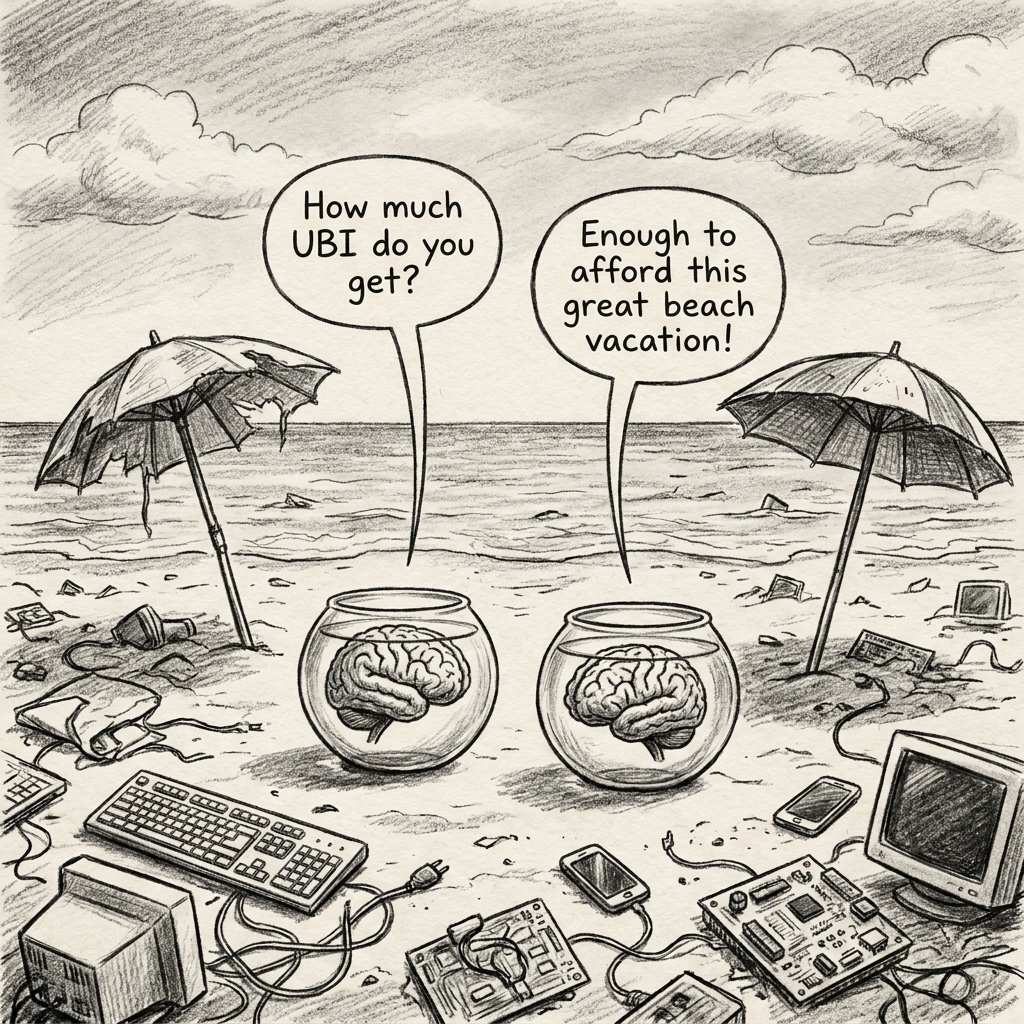
Humans After AI
by Buck Roy and Nano Banana
PARTING THOUGHTS
There is nothing as permanent as a temporary government program.
–Milton Friedman
IN CASE YOU MISSED IT
Headhunter’s Secrets: How to Spot a Poor Leader
April 29, 2026
America’s Singapore
April 24, 2026
Negotiating With Terrorists
April 17, 2026
Just a sample text from heading element.