We Need Conservatives and Liberals
February 13, 2026
Doug Leyendecker

Welcome to This Week’s Leyendecker View
Life can be wonderful, if you’re not afraid of it.
– Charlie Chaplin
FAVORITE READS OF THE WEEK
An AI breakthrough that will go down in history
If enough humans are around to read it.
The end of us: An autopsy of the human essence
A brilliant piece on the taming of our humanity.
MUST WATCH OF THE WEEK
Ross Douthat sits down with Anthropic’s CEO
“We don’t know if the models are conscious.”
THINKING OUT LOUD
We Need Conservatives and Liberals
Of course, but there’s more at play today
We are a divided country. I’m not referencing our current polarization. We are divided not so much by design but by evolution. The Constitution established a system with no formal parties, but over time electoral rules and political incentives led two major parties to dominate. Since then, productive tension between the parties has remained, sometimes leading us astray and sometimes finding solutions to our challenges. In absolute terms, it is not the two-party system that imperils us today. It’s a populace who fails to see just how much we need each other that could tip us into ever dire challenges.
When conservative thinking dominates too much, we risk losing our soul. Total meritocracy leaves little room for the less fortunate and marginalized, and it was the less fortunate and marginalized of Europe who founded this country. When values are too conservative, too rigid, there is little room for creativity. Art and music become stiff, fenced in by fear of the new. As Picasso said, “Every act of creation is first an act of destruction.” Conservatives tend to hold onto the past too firmly.
When liberal thinking dominates too much, we risk going broke. There are economic limits to empathy. The more “free” stuff we provide, the more we encourage and entice more freeloaders. If necessity is the mother of invention, then eliminating necessity produces an addiction to free stuff and little development and progress. The disadvantaged can become wards of the state. And free thinking that’s unencumbered by social and economic consequences can easily lead us to personal and economic decline. Without meritocracy, we flounder.
We, as a country, are out our best when there’s productive and healthy tension between our two political camps. In practice, this looks like Republicans and Democrats hashing out serious policy decisions together to find common ground and then compromise—policies that a critical mass of Americans favor, such that no critical mass of voters is tempted to the extremes of their side. It looks like friendly foes—people who debate with emotion during the day and meet for drinks at night. In fact, until a couple of decades ago, that was the norm in DC. If not friends, politicians were civil to each other. And this civility allowed for a government that worked not perfectly, but enough to keep our country the shining city on the hill.
But those days feel bygone and have for quite some time. We’d be hard pressed to find anyone who believes that the political tension we’ve all been enduring for quite a while is anything approaching productive. In fact, it’s easy to fear, at times, if we’re heading toward some kind of civil war.
The problem is that we’re too distracted by a blame game that never stops. We’re too fixated on catching the other side doing or saying something that our side can then parlay into a righteous viral social media clip. We’re so hellbent on reducing the other side to some sort of evil caricature that we’re failing to ask the question: Why? Why is this happening?
The answer to that question is the true threat to our economic and social stability. If we could only stop our obsession with our political adversaries and resist the urge to blame every ill on them, we’d see the problem staring at us, the apex predator at our gates: exponential technological advancements that rapidly alter the world.
While social media’s influence on our polarization is being inspected and studied, we intuitively know it is driving a menacing wedge between us. We don’t need data. We see it, we live it. It has been detrimental to our children’s mental health, social well-being, and academic success. It has replaced reading and self-study about civic responsibility and policy debates. It’s traded nuance perspectives for 30-second, overly simplified soundbites. It’s hijacked our brains, hooking people into endless dopamine hits of short content that turns off the prefrontal cortex (where deep thought happens) and activates the lizard brain (the hyper-reactive, fear-based brain), radicalizing people along the way. And on top of all this, it’s a Trojan horse for malicious actors—individuals and countries—who seek to infect our country with lies about our political sides to further stoke civil war.
Technology is rewiring our brains, apparently in a way that is making us susceptible to simplistic, ignorant thinking and tribalism. Increasingly, people are arguing that this perfect storm of technology and propaganda are making us less human. People are arguing that while technology tries to remove friction and anything hard from everything, it’s robbing us of the very things in life that make us feel real. The less human we feel, the easier it is to dehumanize our political adversaries, so the more of this we will do.
And all of this without even mentioning AI, a technology that is about to change our world in ways we can’t even imagine.
Yes, our political polarization is real and requires attention. Yes, we as a country must restore that productive and healthy tension that creates better policies while simultaneously engendering the common ground that unifies our country. But we will only do this if we can somehow come together to confront the real threat peering in the bushes. And it’s not the other political side.
THE RANDOMS
The most important three words for a productive conversation might be “May I finish?” Similarly, allowing others to finish when they ask may be the other side of that coin.
AI is progressing so fast every day that humans may just decide not to use it. But what if there’s no way to opt out?
AI is doing to white-collar jobs what the global outsourcing of labor did to blue-collar jobs, but much much faster.
China wants to win the humanoid robot race. I say, let them. Who needs a humanoid robot to mow grass, cook food or wash, dry and fold clothes. The future of robots is likely single-task masters, like an assembly line welding bot, or maybe a self-driving car. It might be reasonable to expect people will have no more interest in humanoid robots than we’ve had in those virtual reality headsets.
Early this week, I paid $2.019 for a gallon of gas at Buc-Eee’s in Katy, TX. The same day, a gallon of gas in California cost $4.338. That, plus higher real estate costs, insurance rates, taxes, and everyday consumer goods gets you some really nice weather and really nice beaches. Worth it?
The old saying is that it takes money to make money. But this doesn’t preclude the not rich from having great ideas. Great ideas, dogged determination, and some right place/right time luck make plenty of people rich.
If Zelensky would take a page from Trump’s negotiating style, Ukraine’s position with Russia might go something like this: “We want all our territory back. We want $2 trillion in reparations for the property Russia has destroyed. And we want Russia to apologize to us in front of the United Nations. Our reparation demands will only grow every day that Russia keeps attacking us.” Why should Ukraine demand anything less?
If you were a dog breed or a mixture of dog breeds, what would you be?
ECONOMIC NEWS
Economy
US job growth exceeds expectations
Healthcare is biggest job growth engine
The US economy is about to boom
Goldman Sachs’ CEO believes it
Capital is winning out over labor
Labor
IBM to triple entry-level hiring
AI is wiping out white-collar jobs
Why it’s so hard to find a job
AI won’t replace middle managers
The Lone Star
Austin housing getting a lot more affordable
Cheniere wants to build another Corpus LNG plant
2026 to be big year in Houston
BUSINESS
Finance
Will AI replace wealth managers?
Alphabet selling 100-year bonds
US PE needs a new approach
The secondary market needs more money
Real Estate
AI hits commercial real estate stocks
Home sales are in the ditch
High earners driving the affordability crisis
Rocket’s CEO says US is tale of two cities
Tech
Detroit loses $50B on EVs
SaaS is dead, long live SaS
Meta on trial again
Big tech is outspending their cash flows
Here comes the Jetsons’ space car
A robot smaller than a grain of salt
AI
AI use is leading to burnout
AI rivals team up for a start-up
Vertical AI is the next big wave
The biggest investment binge in history
Math start-up cracks 4 unsolvable problems
AI Backlash
AI safety leader says the “world is in peril”
Anthropic’s safeguard leader resigns
Top OpenAI exec fired over porn launch
Another AI exec warns of job destruction
Energy
EV batteries out, energy storage batteries in
Kuwait seeks to use US shale technologies
Global oil demand to keep rising
While wind power additions set to fall
THE NATION
Politics
The $30B state welfare slush fund
Musk gives money to Republicans
NY State set for population decline
Women more than men support political violence
Policy
House tightens up voter-ID requirements
Trump rolls back Obama’s climate regulation
And tells military to buy more coal power
US should take heed of Japan’s bond market
Is free bus service a good idea?
Trade
House defies Trump on Canadian tariffs
A US-based Chinese factory clobbers its competition
US and India reach interim trade deal
Culture
Six ways to improve schools
The world is becoming more insular
New Jersey clamps down on e-bikes
GEOPOLITICS
Global
Venezuela loosens oppression
Mexico abandons Cuba
Japan is going MJGA
Big business sours on South Africa
US and Argentina sign sweeping trade bill
Europe
Europe is stuck in the past
Can China help the UK kick start growth?
Why can’t Europe deal with Russia?
Ukraine
Starlink shutdown hobbles Russian forces
Greek venture to supply Ukraine with LNG
China provides Russia with an LNG market
Hungary gets to keep buying Russian oil & gas
Middle East
Iranian leaders target their own politicians
Iran says it’s open to nuke site verification
Hamas can keep some weapons in new Gaza plan
Israel pushes power into the West Bank
Syria cuts deal with Chevron and Qatar
China
China steps up Taiwan pressure
Why iPhones rule China
China tells US not to sell arms to Taiwan
War Creep
Germany prepares for war
NATO warship practices hunting Russian subs
Pentagon prepares second carrier for Middle East
Investors pour billions into EU defense
MAKING A BETTER YOU
Health
Microplastics panic may be overblown
Cellphone radiation to be studied
Tailored gene-editing treatments are coming
Mind
Using boredom to enhance performance
Can you rewire your brain?
How to reconnect with your intuition
Body
Coffee lowers dementia risk
The best sports for longevity
How to use kettleballs
FUN STUFF
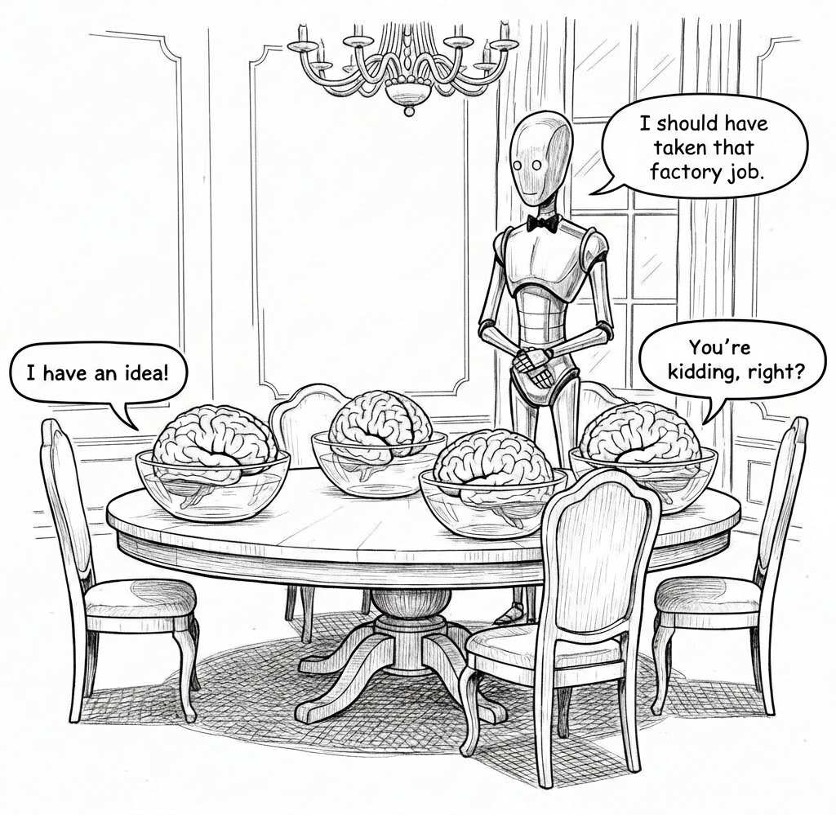
Brains in Bowls
by Buck Roy and Nano Banana
The Extraordinary
Wildlife photos of the year
100 marathons in 100 days
Why is Finland so happy?
Music That Found Us
Andrea Bocelli, Olympic opening song
“As Time Goes By” from Louis Armstrong.
Beethoven’s “Ode to Joy” on piano
Worth a Watch
Chris Hemsworth in Crime 101.
Bad news for nepo babies in Send Help.
The new Dracula series.
The Yum Yums
Seafood soups.
Julia Child’s bouillabaisse
Classic ciopinno
Classic creamy lobster bisque
Sweet potato and crab soup
Authentic New Orleans gumbo
Easy Thai shrimp soup
PARTING THOUGHTS
You can’t get too much winter in the winter.
–Robert Frost
IN CASE YOU MISSED IT
Uncertainty, the New Normal
February 5, 2026
Our Politics Can Be Brutal
January 30, 2026
Why Economic Growth Matters
January 23, 2205
Just a sample text from heading element.